
Descrizione
Collana International Law and Human Rights
About the book
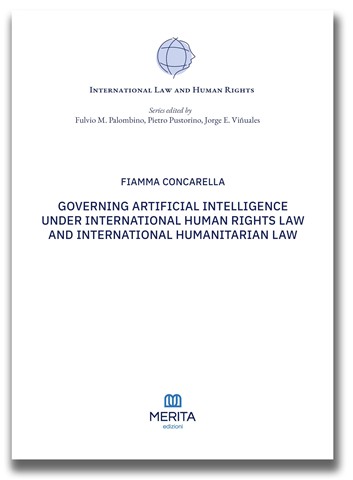
Artificial Intelligence has emerged as one of the most significant contemporary challenges for public international law. The increasing capacity of AI systems to process large quantities of data, generate inferences, adapt their operation and perform functions with progressively reduced human intervention raises questions concerning the adequacy, interpretation and progressive development of existing international legal rules.This monograph examines Artificial Intelligence from the perspective of public international law, with particular emphasis on international human rights law and international humanitarian law. Its analysis proceeds from the premise that AI does not operate in a legal vacuum. Existing rules of international law remain applicable to activities involving AI systems and continue to provide the fundamental normative framework within which their development and use must be assessed.
The study investigates the fragmented architecture of international AI governance and the interaction between international and regional instruments, domestic legislation, ethical frameworks, technical standards and soft-law principles. Particular attention is devoted to the implications of increasingly autonomous decision-making for internationally recognised rights, including privacy, equality and non-discrimination, freedom of expression, liberty and due process, as well as to the application of international humanitarian law to autonomous weapon systems and AI-assisted military operations.
Questions of meaningful human control, foreseeability, attribution, accountability and State responsibility constitute a transversal dimension of the analysis. The central argument is that the principal challenge posed by Artificial Intelligence does not consist in the absence of applicable international law, but in the need for greater coherence between regulatory regimes and the effective interpretation and application of existing international legal obligations.
From this perspective, the future international regulation of AI must preserve the continuity of the international legal order while ensuring that technological innovation remains compatible with human dignity, the effective protection of internationally recognised rights, the rule of law and the fundamental principles governing the protection of individuals both in peacetime and in armed conflict.
About the Author
Fiamma Concarella is Adjunct Professor of Human Rights and Armed Conflict at LUISS Guido Carli University and holds a PhD in International Law, with a doctoral thesis examining the implications of artificial intelligence for human rights and the law of armed conflict. Alongside her academic work, she practises as a lawyer in Rome.